
Household Chlorine Dosing Station
A measured-dose bottle and dispenser that makes safe chlorination routine instead of guesswork — the cheapest disease barrier in the water chain.
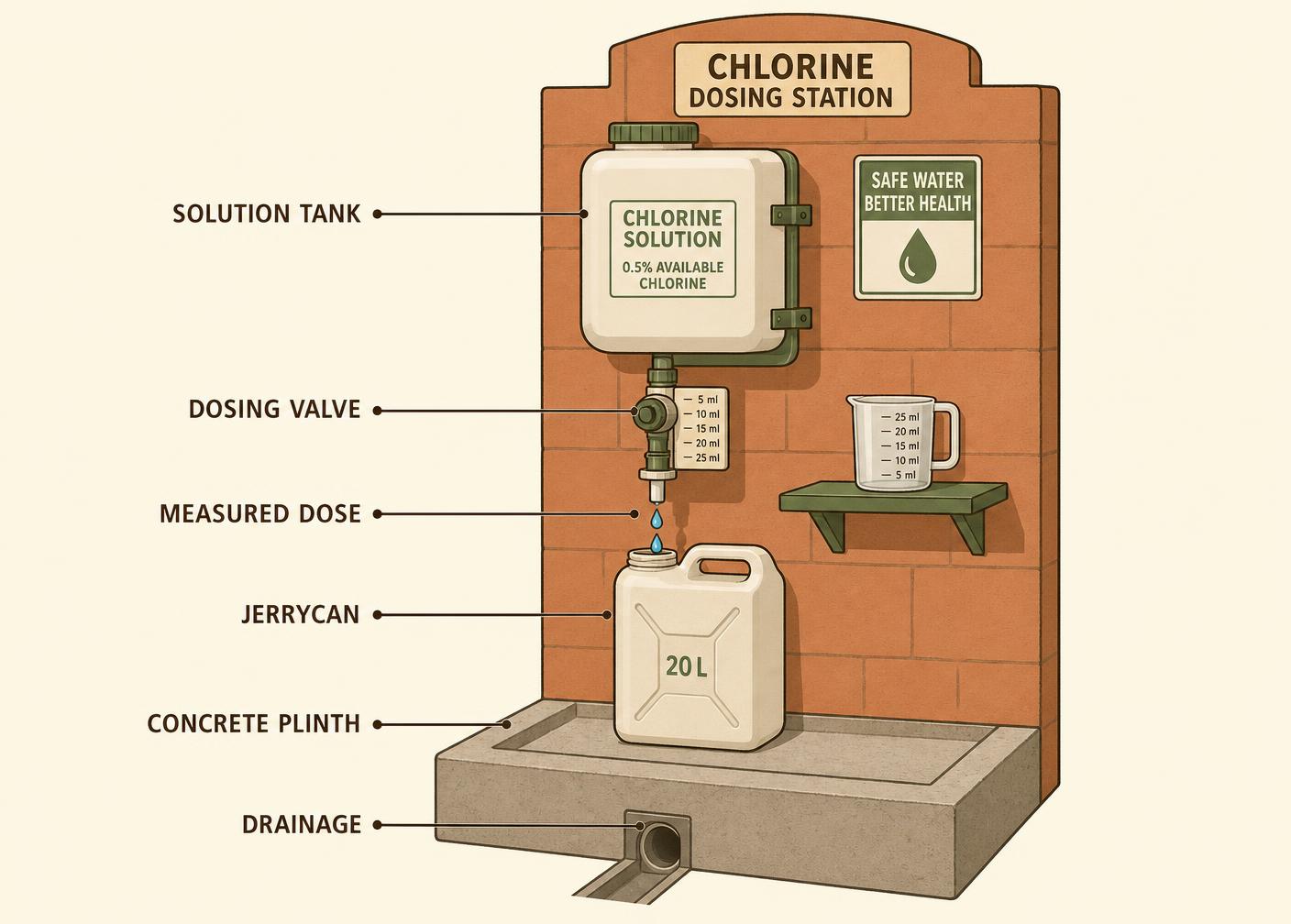
- Estimated cost
- $5 – $20 plus roughly $0.50 a month for chlorine
- Skill level
- Beginner
- Time
- 2 hours to build, 30 seconds per use
Not yet verified
No confirmed build with photo proof has been submitted for this plan yet. Built it? Send photos and it earns the badge.
Tools
- Drill or hot nail
- Knife
- Measuring syringe or bottle cap
- Marker
Short a tool or material? Builders below have often swapped something local in — read Local adaptations before you buy anything.
Materials
Dimensions & cut list
A gravity-fed dosing point treating a 1,000 litre community tank with sodium hypochlorite. These are the reference sizes from Appropedia — scale them to what you have, but keep the ratios.
| Target free chlorine after 30 min | 0.2–0.5 mg/l at the tap |
|---|---|
| Dose for clear water | ≈ 2 mg/l applied, i.e. 1.3 ml of 1.5% solution per 10 litres |
| Contact time before use | 30 minutes minimum |
| Stock solution strength | 1% for household dosing bottles |
| Stock shelf life | 30 days in a dark bottleHypochlorite loses strength fast in sun and heat |
| Dosing bottle | 3 ml calibrated dispenser cap |
| Turbidity limit | Under 5 NTUFilter first — chlorine cannot treat cloudy water |
Take this list to the yard
- As per volumeSodium hypochlorite (or on-site electrolytic generator)
- 2Dark HDPE stock containers, 20 litre
- 1Calibrated dosing dispenser
- 1Free-chlorine test kit (DPD)Dosing without testing is guessing
- 1Cloth pre-filter or sand filter upstream
- 1Lockable shaded cabinet
Step by step
Step 1 of 6
Know your dose
For clear water, roughly 3 ml of 1% sodium hypochlorite treats 20 litres. Turbid water needs filtering first — chlorine is consumed by the dirt instead of the germs.
Swipe or use arrow keys
1. Know your dose
For clear water, roughly 3 ml of 1% sodium hypochlorite treats 20 litres. Turbid water needs filtering first — chlorine is consumed by the dirt instead of the germs.
2. Calibrate the dispenser
Measure the actual delivered volume of your valve or cap three times with a syringe and mark the fill line. Guessed doses either fail or taste undrinkable.
3. Mount it where the water is collected
Fix the dispenser at the collection point — the tap, well head or storage container — at hand height. Convenience is what keeps chlorination happening daily.
4. Dose, stir and wait 30 minutes
Add the dose to the full container, stir, cover it and wait a full 30 minutes before drinking. The contact time is what does the killing.
5. Check the residual
Test after 30 minutes: aim for 0.2 – 0.5 mg/l free chlorine. No residual means the dose was too small or the water too dirty.
6. Store the stock properly
Keep chlorine solution in a cool, dark, tightly capped bottle and replace it every one to three months — it loses strength on the shelf, faster in heat.
Why mine failed
The ways this build usually goes wrong, and what fixes it.
Water tests show no chlorine at the tap
CauseStock solution has degraded, or turbidity is eating the dose
FixMix fresh stock every 30 days and keep it in a dark bottle out of the heat. Filter the water below 5 NTU first — cloudy water consumes chlorine before it can disinfect.
People complain about the taste and stop drinking it
CauseOver-dosing
FixTest and aim for 0.2–0.5 mg/l free chlorine 30 minutes after dosing. Overdosing loses community trust faster than anything else.
Dose varies wildly between operators
CauseEyeballed measuring
FixUse one calibrated dispenser cap, mark it, and write the dose per container size on the wall in the local language.
Stored water is re-contaminated anyway
CauseDipping cups into the storage vessel
FixPair dosing with a narrow-mouth, tapped storage vessel. Treated water plus a dirty cup equals untreated water.
Safety notes
- Never mix chlorine with acid, vinegar or ammonia cleaners — it releases toxic gas.
- Store the stock bottle out of reach of children and clearly labelled.
- Chlorine does not kill cryptosporidium; filter first and boil if illness is present.
Source & attribution
This plan is our build-step write-up of work documented by Appropedia. The original design and documentation belong to them — go read the source before you build.
Household water chlorinationLocal adaptations
What builders changed to make this work where they live.
- No adaptations shared yet for this plan.
Build this alongside
Plans that use the same materials or serve the same need.
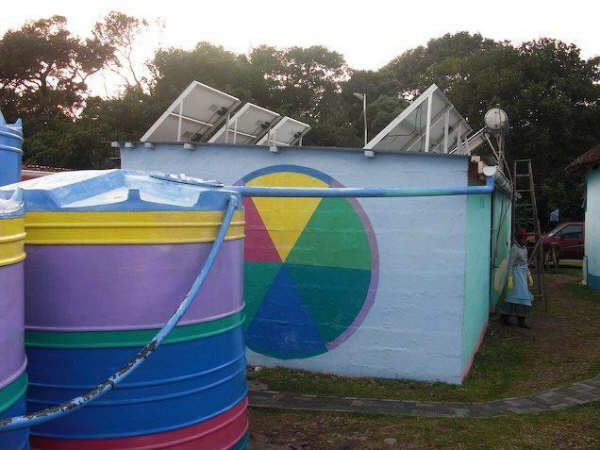
Rooftop Rainwater Harvesting with First-Flush Diverter
Catch and store roof runoff, and throw away the dirty first few litres automatically so what reaches your tank is worth storing.
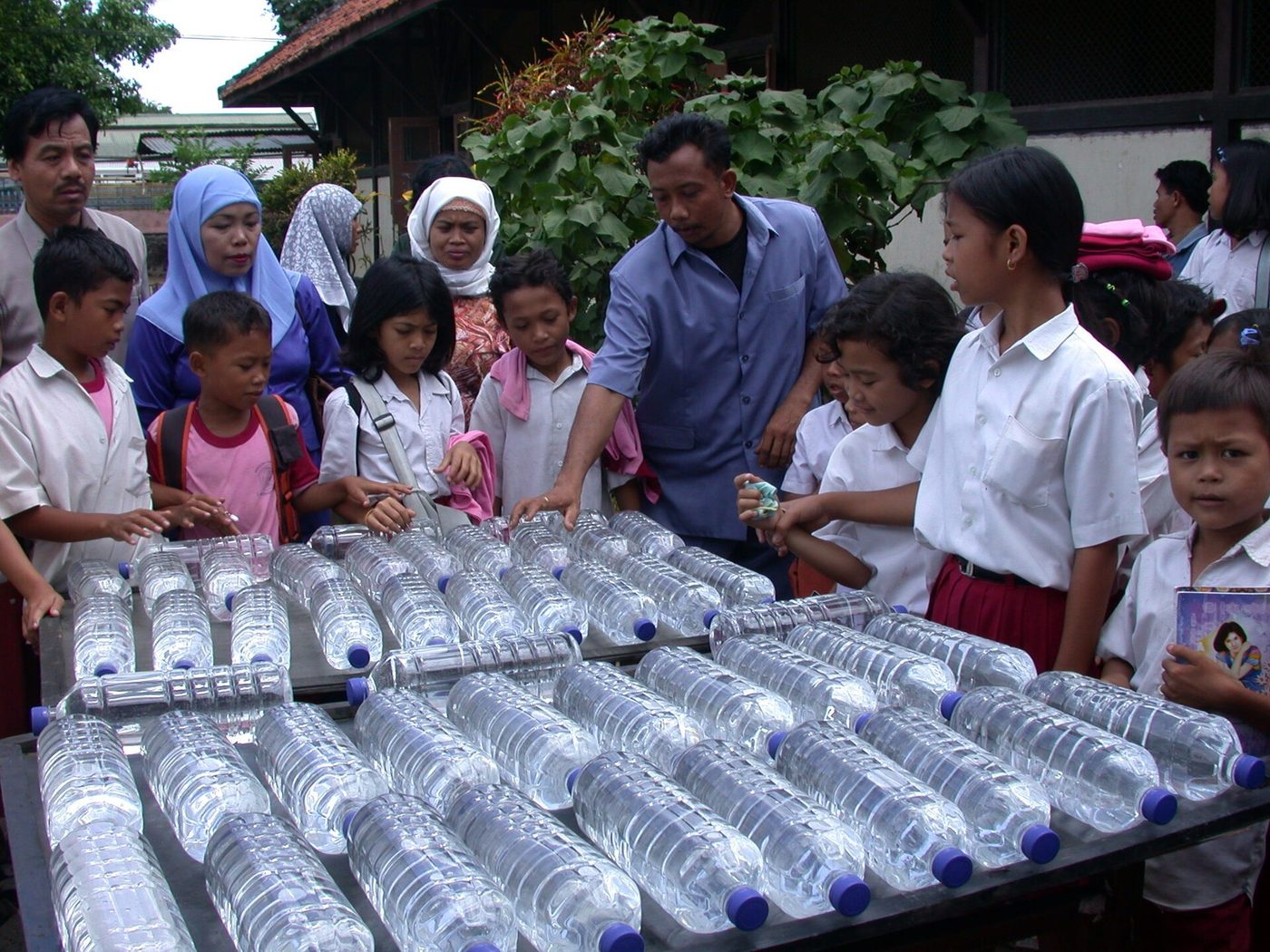
SODIS Solar Water Disinfection Rack
Clear PET bottles on a black-painted roof rack, using six hours of sun to make biologically safe drinking water at no running cost.
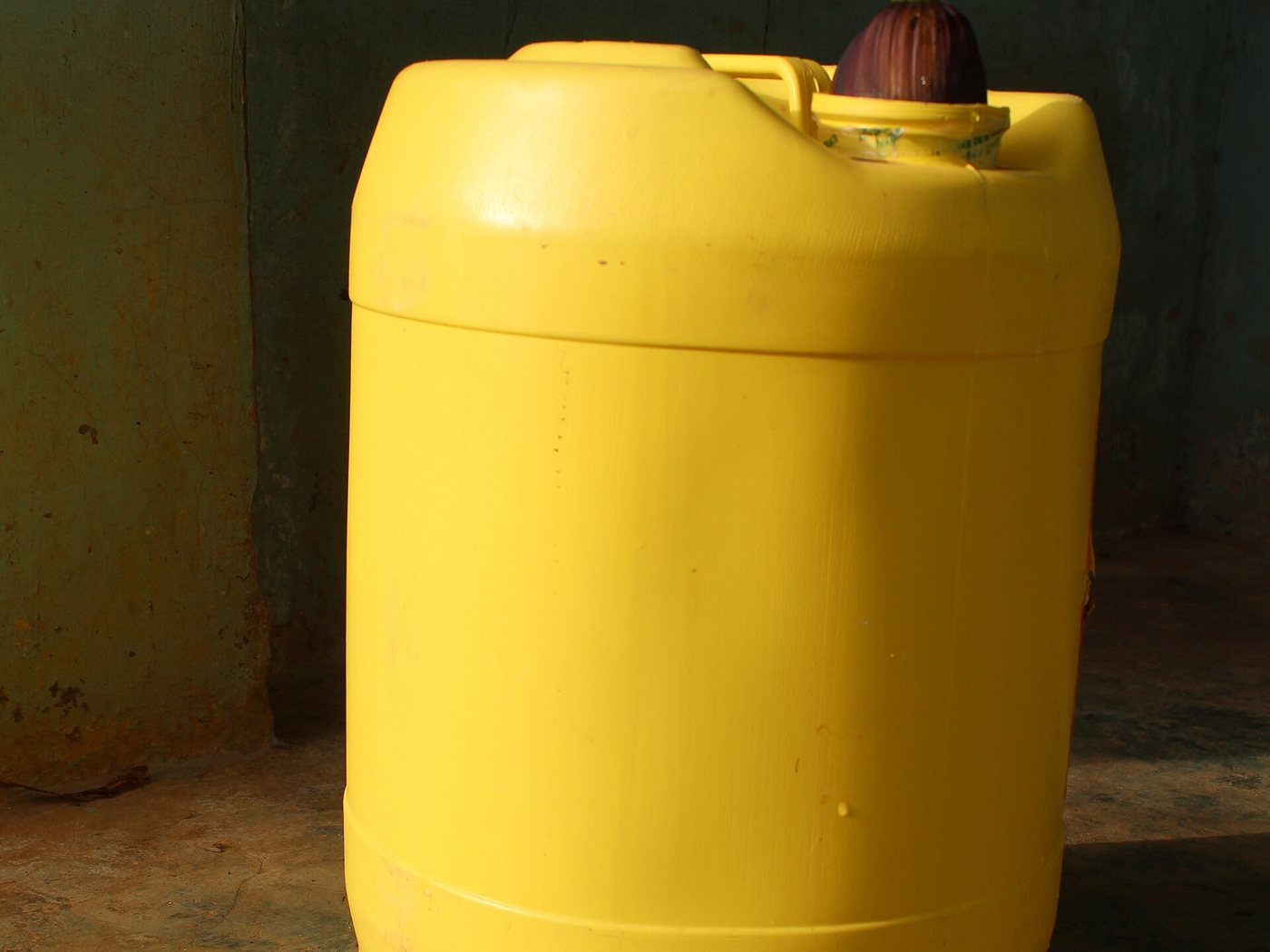
Safe Water Storage Vessel
Convert an ordinary jerrycan or clay pot into a narrow-mouth, tap-fitted, lidded storage vessel so treated water does not get recontaminated by hands and cups.