Lee Hite Eco-Briquette Lever Press
The EWB-documented lever press that squeezes soaked waste paper and biomass into dense fuel briquettes — the design with real numbers behind it.
- Estimated cost
- $25 – $90 in timber, pipe and hardware
- Skill level
- Intermediate
- Time
- 2 days to build, then continuous production
Not yet verified
No confirmed build with photo proof has been submitted for this plan yet. Built it? Send photos and it earns the badge.
Tools
- Hand saw
- Drill and bits
- Welder or bolt kit
- Spanner set
- Hacksaw
- File
If you don't have it
- No welder? Build the frame from hardwood and through-bolt every joint with M10 bolts and washers. Lee Hite's own bolted version works; it just needs the joints re-tightened after the first week of pressing.
- No steel pipe for the mould? Use a thick-walled hardwood cylinder, or an old steel food tin sleeved inside a hardwood collar so it does not split. Drill the drainage holes the same way.
- No cassava or maize starch? Soaked waste paper is itself the binder — raise the paper share of the mix instead of buying starch. Clay slip at about 5% also holds briquettes together, but it lowers the heat output.
Materials
- Hardwood or steel frame members for the base and uprights
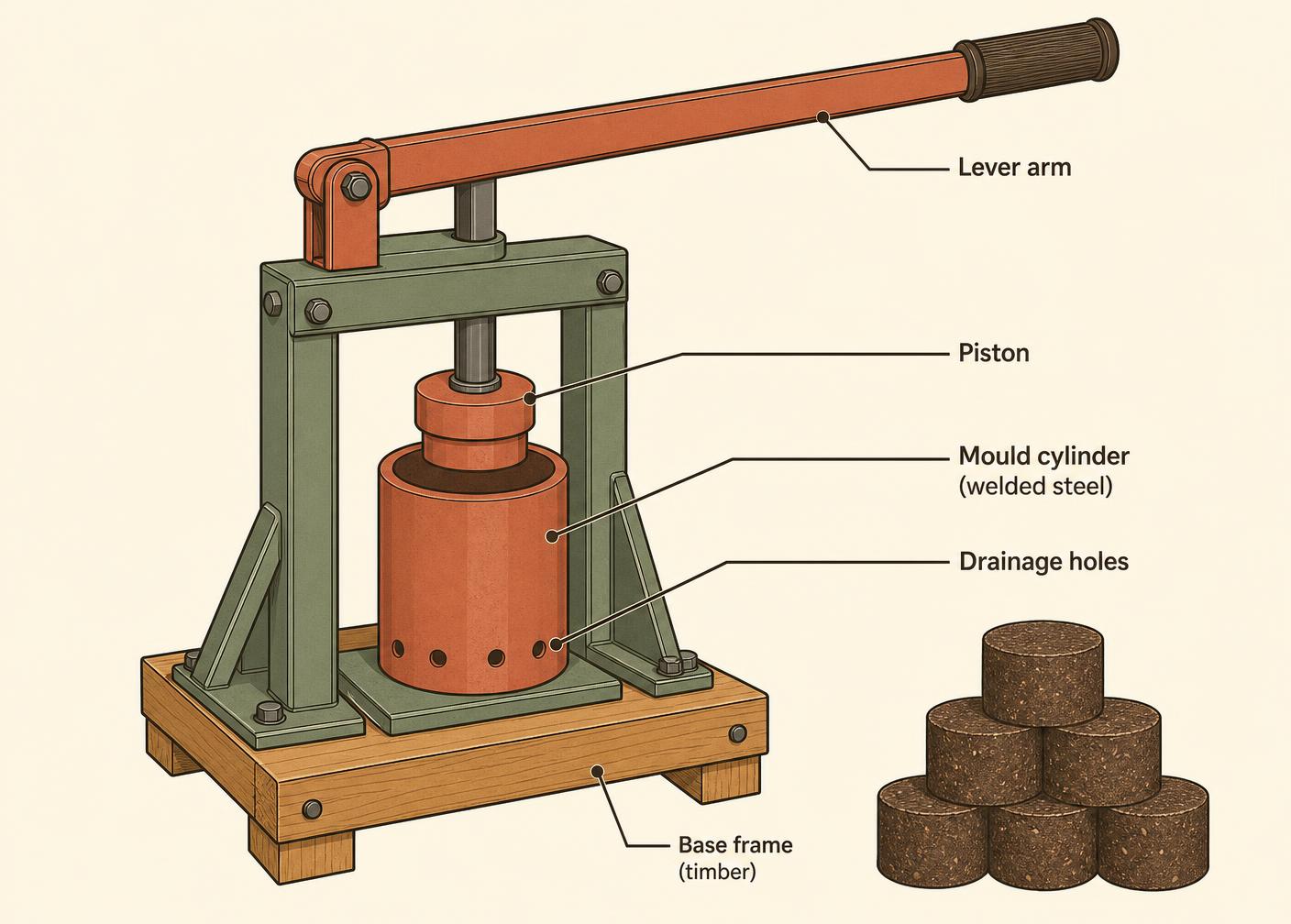
- A steel or hardwood cylinder mould, 100 – 150 mm diameter, drilled with drainage holes
- A close-fitting piston plate on a stem
- A lever arm about 1.2 – 1.5 m long with a pivot pin
- Soaking drum, sieve and drying racks
Dimensions & cut list
One lever press producing 200–400 briquettes a day, following the Lee Hite / EWB write-up. These are the reference sizes from Lee Hite / Engineers Without Borders — scale them to what you have, but keep the ratios.
| Forming tube | 100 mm internal diameter, 200 mm long |
|---|---|
| Briquette height | 60–80 mm after pressing |
| Core pin | 25 mm, centredThe hollow core is what lets a briquette burn cleanly |
| Lever arm | 1.2 m, pivoting 150 mm from the ram |
| Mechanical advantage | About 8:1 at that pivot |
| Drain holes | 6 mm holes at 25 mm spacing around the lower tube |
| Frame | Bolted 50 × 50 mm angle or hardwood, 900 mm working height |
Take this list to the yard
- 200 mm lengthSteel pipe, 100 mm bore
- 300 mmSolid bar or pipe for the core pin, 25 mm
- ≈ 6 mAngle iron or hardwood for the frame
- 12Bolts, M10Bolted throughout if you have no welder
- 1.2 mLever pipe
Step by step
Step 1 of 7
Build the frame square and heavy
The press works by leverage against the base — a light frame walks and racks. Bolt or weld a rigid rectangle and anchor it to the ground or a heavy bench.
Swipe or use arrow keys
1. Build the frame square and heavy
The press works by leverage against the base — a light frame walks and racks. Bolt or weld a rigid rectangle and anchor it to the ground or a heavy bench.
2. Drill the mould for drainage
Perforate the cylinder wall with 4 – 6 mm holes over its full height. Water must escape sideways as you press; a solid mould just makes a wet plug that never dries.
3. Set the lever ratio
Pivot the arm so the piston sits close to the fulcrum and the handle far from it. Lee Hite's write-ups show force multiplication is what gives a dense briquette a person can actually make all day.
4. Mix to a ratio you can repeat
Work by volume of soaked pulp, not by eye. A reliable starting mix is 1 part soaked paper pulp to 1 part sawdust or char fines, plus about 5% cooked cassava or maize starch paste if the briquettes crumble when dry. Write the ratio on the wall of the shed — the whole point of the EWB numbers is that a repeatable mix gives a repeatable briquette.
5. Soak and pulp the feedstock
Soak shredded waste paper, cardboard or crop residue for one to three days until it breaks down to pulp with no hard flakes, then mix in char fines or sawdust up to about half the volume.
6. Press, eject and dry
Fill the mould, press hard and hold the lever down for 10 – 15 seconds so the water keeps running out, then release and eject the briquette onto a rack. Aim to lose most of the free water at the press, not in the sun. A person working steadily makes roughly 200 – 400 briquettes a day on this press.
7. Dry hard before burning
Dry on raised racks in full sun with airflow underneath for one to three weeks. Two tests for done: the briquette rings rather than thuds when tapped, and a briquette split in half is the same colour all the way through with no dark damp core. Allow about 1 m² of rack for every 40 – 50 briquettes in the queue.
Why mine failed
The ways this build usually goes wrong, and what fixes it.
Briquettes crumble as soon as they leave the mould
CauseNot enough binder, or the mix is too dry
FixRaise the soaked-paper or clay-soil binder toward 1:1 by volume and re-test: a squeezed handful should hold its shape without dripping.
Briquettes smoke heavily when burned
CauseStill damp inside, even though the outside feels dry
FixDry 14–21 days raised and ventilated, turning every 3 days. Break one open — a dark damp core means it needs longer.
Ram jams in the tube
CauseWet pulp packed against blocked drain holes
FixClear the 6 mm drain holes after every session and drain the mix before loading. Water has to have somewhere to go.
Output is far below 200 a day
CauseDrying space, not pressing speed, is the bottleneck
FixBuild rack space for three days of output before adding a second press. Almost every briquette enterprise fails at drying, not pressing.
Safety notes
- Keep hands clear of the mould mouth while the lever is loaded — the arm stores real energy.
- Anchor the press; a tipping press under load can break bones.
- Never use briquettes made from painted, treated or plastic-contaminated waste indoors.
Source & attribution
This plan is our build-step write-up of work documented by Lee Hite / Engineers Without Borders. The original design and documentation belong to them — go read the source before you build.
EWB briquette press project documentationLocal adaptations
What builders changed to make this work where they live.
- No adaptations shared yet for this plan.
Build this alongside
Plans that use the same materials or serve the same need.
Lever-Arm Charcoal Briquette Press
Press agricultural waste and charcoal dust into burnable briquettes, turning a disposal problem into cooking fuel or a product to sell.
Waste Paper & Leaf Briquettes
The simplest fuel in the library: soak waste paper and dry leaves, press by hand in a perforated tin, dry hard, and burn what would have been rubbish.
Batch Solar Water Heater from a Salvaged Tank
A black-painted tank in a glazed, insulated box that gives hot washing water by mid-afternoon with no pump, controller or electricity.