
Rope-and-Washer Pump
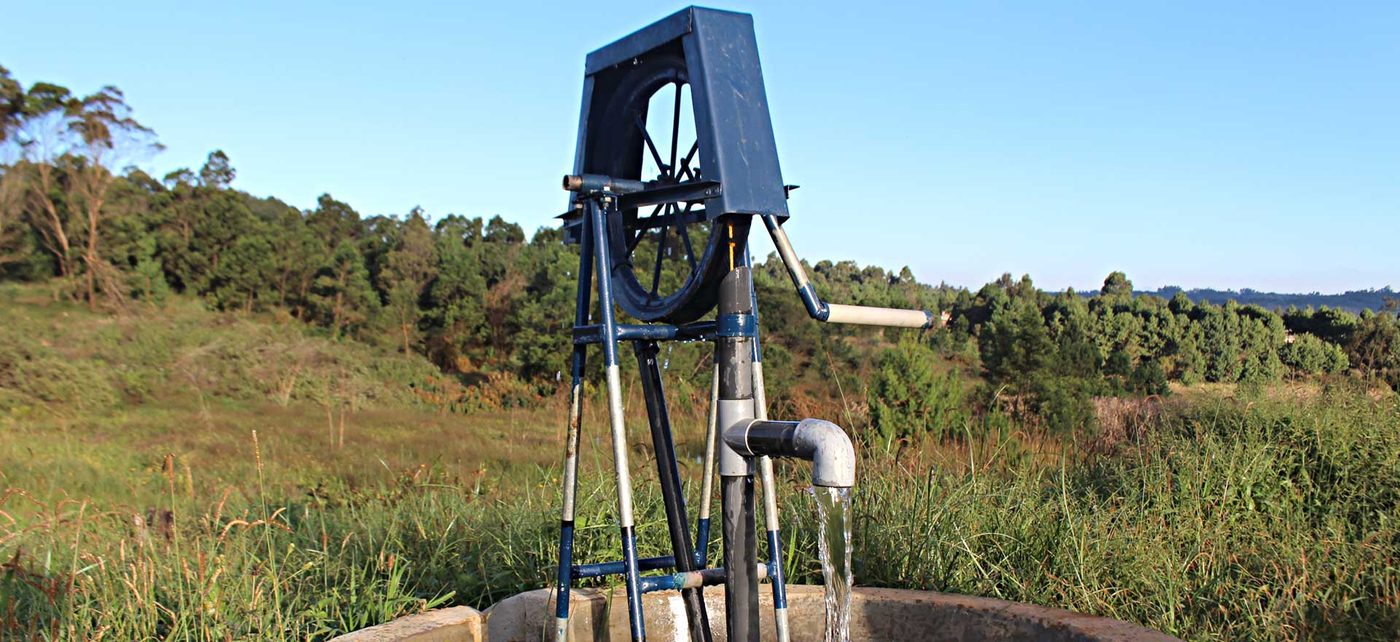
A hand-cranked loop of rope with rubber washers that lifts water up to about 35 metres, built almost entirely from salvage.
- Estimated cost
- $60 – $200 depending on depth and pipe cost
- Skill level
- Intermediate
- Time
- 2 – 3 days
Why this is a Verified Build
Photo-verified installation on a 14 m hand-dug well in Nyanza, Rwanda (2025), delivering roughly 25 L/minute with a child on the crank.
Tools
- Welder or drill and bolts, if you cannot weld
- Angle grinder or hacksaw
- Drill with hole saw
- Spanners
- Sharp knife or punch for cutting washers
If you don't have it
- No moulded polythene pistons? Cut washers from an old truck tyre inner tube or flip-flop rubber and knot them onto the rope at 1 m spacing — the standard field repair.
- No bicycle wheel? Build the drive wheel from two discs of 18 mm plywood with a tyre strip glued around the rim for grip.
Materials
- Old car or bicycle wheel rim for the pulley
- Steel bar or pipe for the crank and frame
- PVC rising main, 25 – 32 mm, to the depth required
- Polypropylene rope, 5 – 6 mm, roughly 2.2 × well depth
- Old car tyre or HDPE for washers
- Bearings or hardwood blocks for the axle
- Ceramic or PVC guide box for the pipe inlet
Dimensions & cut list
A hand-cranked rope pump on a hand-dug well or borehole down to about 25 m. These are the reference sizes from Appropedia / Practical Action — scale them to what you have, but keep the ratios.
| Rising main | 25 mm PVC for lifts to 15 m; 20 mm for 15–25 mNarrower pipe means less water per turn but a crank a woman or child can still turn |
|---|---|
| Piston spacing on the rope | 1 mCloser spacing lifts more but drags harder |
| Piston diameter | 0.5 mm under the pipe boreCut from old rubber sandal or HDPE; it must wipe, not grip |
| Wheel diameter | 50–70 cmTwo lorry tyre sidewalls bolted to a hub, groove kept for the rope |
| Crank handle radius | 20 cm |
| Guide box depth below water | At least 1 m under the lowest dry-season level |
| Output | ≈ 20 litres/min at 10 m; ≈ 8 litres/min at 25 m |
Take this list to the yard
- Well depth + 2 mPVC rising main
- 2 × well depth + 3 m8 mm polypropylene rope
- 1 pairWheel bearings (old wheelbarrow hub)
- 1Ceramic or concrete guide block
- 4 mGalvanised pipe for the frame, 25 mm
Step by step
Step 1 of 7
Size the pipe to the depth
Use 32 mm rising main to about 10 m, 25 mm to 20 m and 20 mm beyond that. Oversized pipe on a deep well makes the crank impossibly heavy for the person who actually fetches the water.
Swipe or use arrow keys
1. Size the pipe to the depth
Use 32 mm rising main to about 10 m, 25 mm to 20 m and 20 mm beyond that. Oversized pipe on a deep well makes the crank impossibly heavy for the person who actually fetches the water.
2. Cut the washers
Punch or cut discs from old tyre tread or HDPE, sized to slide in the pipe with 1 mm clearance. Too tight and the pump binds; too loose and it slips and lifts nothing.
3. Thread the rope
Space washers about 1 m apart along the rope, fixing each with a double knot either side. Take the rope down the rising main, round a guide at the bottom, and back up outside the pipe to form a continuous loop.
4. Build the wheel and frame
Fit the tyre-lined rim to an axle in bearings, mounted on a steel or hardwood frame bolted to the well cover. The rim's rubber gives grip; a bare metal rim slips as soon as it is wet.
5. Fit the bottom guide box
The guide at the base of the rising main is the part that wears out. Use a smooth ceramic insert or a moulded PVC guide, and make it replaceable without pulling the whole pipe.
6. Seal the wellhead
Cover the well with a slab and pass only the pipe and rope through. An open well under a rope pump defeats the sanitary point of the pump entirely.
7. Commission and train
Crank steadily, not violently, and check the flow. Show the household how to change washers and rope, and hang a spare set at the wellhead — a rope pump that nobody can repair is a broken pump within a year.
Why mine failed
The ways this build usually goes wrong, and what fixes it.
Pump turns easily but almost no water arrives
CausePistons too small or worn, so water slips past them
FixMeasure a piston against the pipe bore — more than 1 mm of slack and it will not lift. Cut new ones from old sandal rubber, and keep spares on the frame.
Rope jumps off the wheel
CauseWheel groove worn flat, or the rope is slack
FixRetension by shortening and re-splicing the rope, and re-cut the groove. The guide block at the bottom must sit directly under the wheel — check it is not knocked sideways.
Crank is too heavy for a child to turn
CauseRising main too wide for the lift, or piston spacing too close
FixDrop to the next pipe size down, or space pistons 1.5 m apart. You lose litres per turn and gain a pump the household can actually use.
Safety notes
- Keep fingers, cloth and hair away from the wheel and rope nip point. Guard the pinch between rope and rim.
- The well must stay covered and sealed. A rope pump on an open well still gets contaminated from the surface.
- Test the water before use — a pump makes fetching easier, not the water safer.
Source & attribution
This plan is our build-step write-up of work documented by Appropedia / Practical Action. The original design and documentation belong to them — go read the source before you build.
Rope pump construction and sizingLocal adaptations
What builders changed to make this work where they live.
Claudine U. · Nyanza, Rwanda
Motorcycle tyre tread cut better washers than car tyre — thinner and easier to punch. We keep twenty spares in a tin at the wellhead.
Build this alongside
Plans that use the same materials or serve the same need.

Concrete Biosand Water Filter
A household slow-sand filter in a concrete body that removes most pathogens and turbidity with no power, no cartridges and no ongoing cost.
Treadle Pump for Smallholder Irrigation
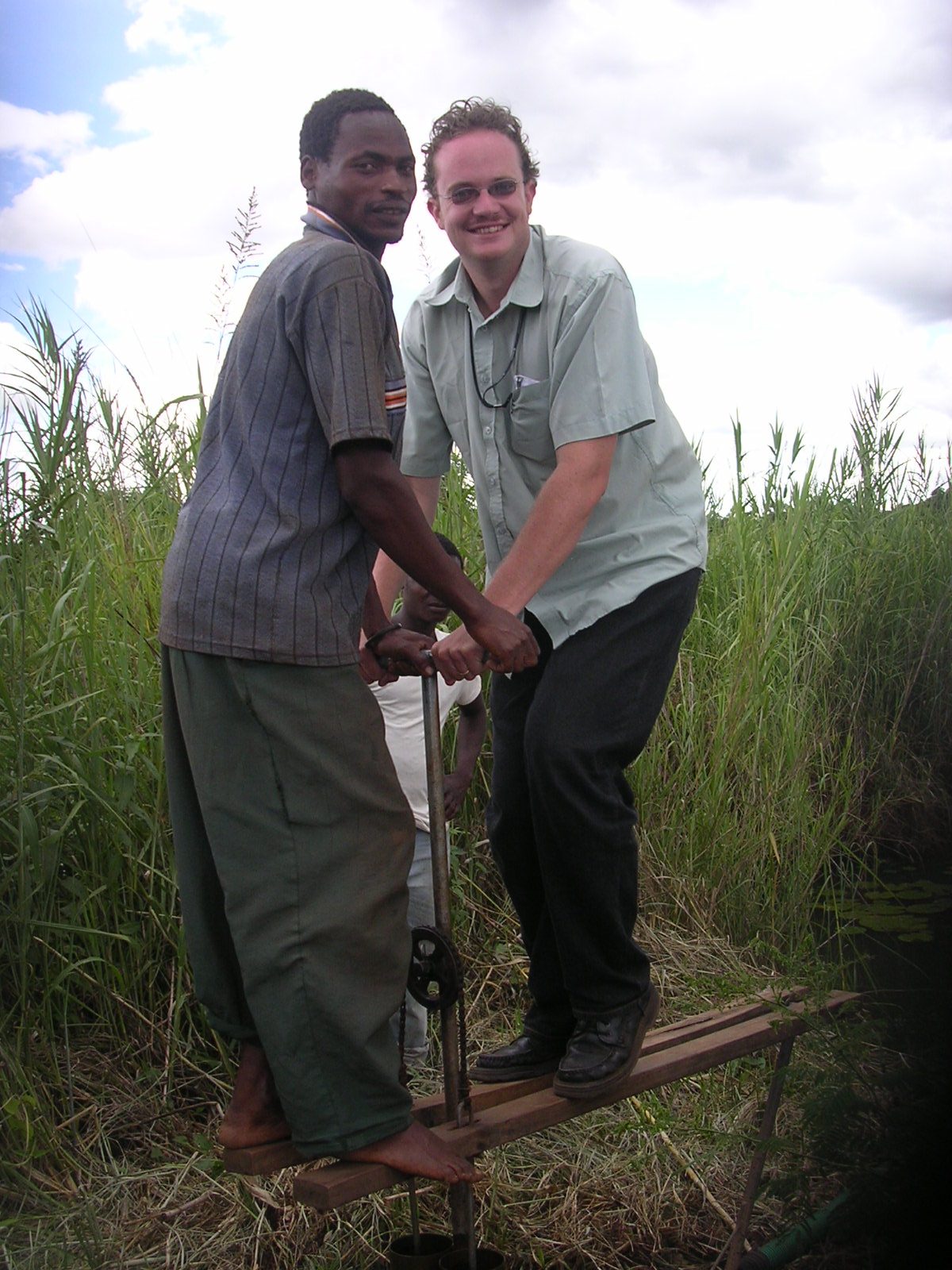
A foot-powered twin-cylinder pump that lifts shallow groundwater or river water for a quarter-hectare plot without any fuel.
Rooftop Rainwater Harvesting with First-Flush Diverter
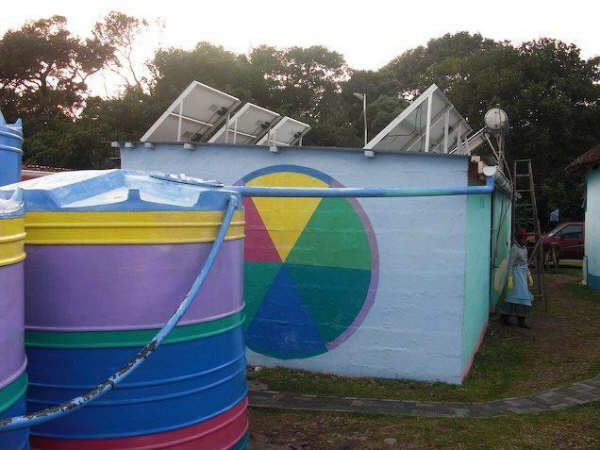
Catch and store roof runoff, and throw away the dirty first few litres automatically so what reaches your tank is worth storing.